How Better QBRs Cut MSP Client Churn Before It Starts
Most MSPs try to fix churn after the cancellation email arrives. The real fix is structural, and it starts with how you run your QBRs and TBRs.

Most MSPs call it a QBR - a quarterly business review, a calendar event that happens because it is on the calendar. Ticket volumes get reviewed. Backup status gets confirmed. Everyone nods and goes back to work. Then, six months later, the client sends a non-renewal notice that seems to come out of nowhere.
It never actually comes out of nowhere. The client has been forming their exit decision for months, and the review meeting that should have caught it - the Technology Business Review - was too shallow to notice. Churn is not a surprise event. It is the visible endpoint of a retention process that failed quietly, meeting after meeting.
Why Churn Starts Long Before the Cancellation Email
By the time a client tells you they are leaving, the decision was made weeks or months earlier. Datto's Global State of the MSP Report finds that MSPs who proactively track client relationship health - not just technical metrics - reduce unexpected churn by up to 40%. The gap between MSPs who catch churn early and MSPs who get blindsided is not luck. It is whether the review meeting is structured to surface warning signs or structured to avoid them.
The signals a shallow TBR never asks about
A ticket-report TBR answers "is the environment stable?" It never asks "has the executive sponsor stopped showing up?" or "has the internal champion who fought for us left the company?" or "have we funded anything from last year's roadmap?" Those are the questions that actually predict churn, and they require a structured client health score to track consistently - not memory, not gut feel.
The Real Reason Most Client Reviews Fail to Retain Anyone
A status-update TBR reinforces exactly the perception an MSP cannot afford: that the relationship is a vendor contract, not a partnership. When the only thing a client hears at a review is ticket counts and uptime percentages, they experience the MSP the same way they experience their electricity provider - a commodity, evaluated on price. We have written before about how commoditization is the real risk behind silent churn. A weak TBR is the delivery mechanism for that risk, one quarter at a time.
The fix is not a better slide deck. It is a different meeting, built around different questions, run on a different cadence for different accounts.
The Five TBR Elements That Actually Move Retention
1. A scored account health picture, not a status update
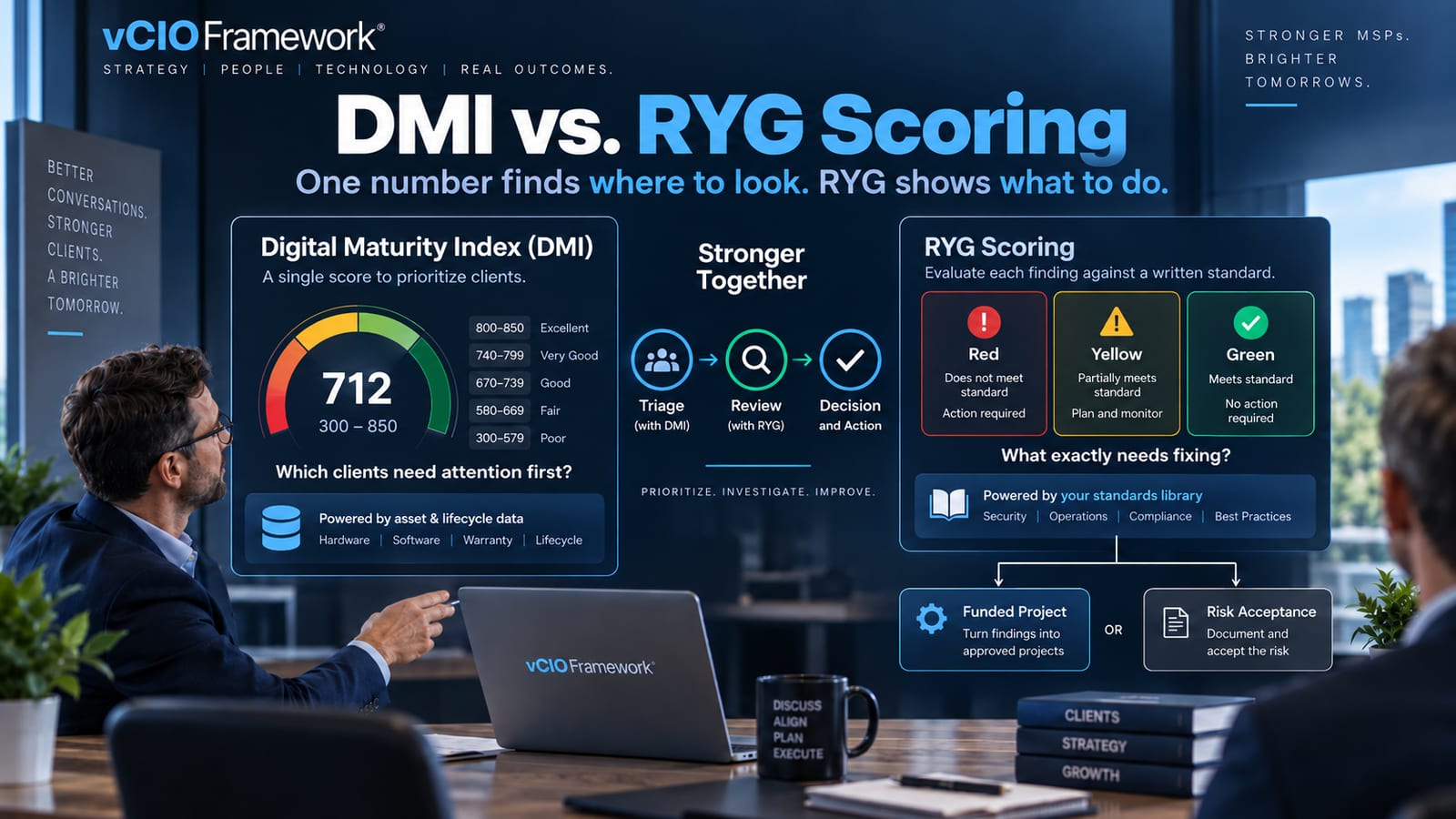
Every TBR should open with a Red, Yellow, Green account health score across technical, relationship, financial, security, and strategic alignment dimensions. A client who sees their own environment scored honestly - including the Yellow and Red areas - experiences the meeting as advisory, not promotional.
2. A mandatory executive presence
If the client's decision-maker is not in the room, the meeting is a status call with a different name. Tier A and Tier B accounts should have a standing requirement for executive attendance at every TBR, escalated personally if it lapses twice in a row.
3. A roadmap that gets revisited, not just re-presented
A roadmap the client has never funded is not evidence of a strategic relationship - it is evidence of one that has stalled. Every TBR should show what moved since the last review, what did not, and why.
4. A documented escalation trigger for at-risk accounts
Certain conditions should force an account into an immediate executive escalation call, outside the normal TBR cadence: no executive meeting in two or more consecutive quarters, a departed internal champion, declining MRR for two consecutive months, or an unresolved security incident past 30 days. Waiting for the next scheduled TBR when one of these fires is how MSPs get blindsided.
5. Action items with owners and dates, reviewed at the next meeting
A TBR that produces no accountable follow-through teaches the client that the meeting does not matter. Every action item needs an owner and a date, and the first agenda item at the next TBR should be reviewing what happened to last quarter's commitments.
Rebuilding Your TBR Cadence Around Retention, Not Just Reporting
Cadence should track risk, not convenience. Tier A - Always Engaged accounts warrant quarterly TBRs and an annual EBR at minimum. Tier B - Betterment Focused accounts can run semi-annually. Tier C - Core Consistent accounts get an annual review. The mistake most MSPs make is running every account on the same cadence regardless of size or risk, which means the accounts most likely to churn get the least attention. For the full agenda structure and discovery question bank, see how to run a TBR that actually generates revenue - the same structure that retains clients is the structure that grows them.
Tier A relationships also need a properly run Executive Business Review at least annually - a different meeting, for a different audience, focused on strategic alignment rather than operational detail. MSPs that only ever run TBRs are missing the meeting most likely to lock in a multi-year relationship.
What Changes When TBRs Actually Work
Industry data suggests annual client churn at MSPs running unstructured, inconsistent account reviews falls in the 15-25% range. MSPs operating structured health scoring, tiered cadence, and defined escalation protocols typically hold churn to 5-8%. On a $500,000 MRR book of business, that gap is the difference between losing $75,000-$125,000 in recurring revenue every year and losing $25,000-$40,000. The TBR is not a reporting obligation. Run correctly, it is the single highest-leverage retention tool an MSP has, because it is the one touchpoint every client experiences on a predictable cycle.
Turning This Into a System, Not a One-Off Effort
None of this works as a one-time fix. It works as a system: a scored health rubric, a tiered cadence, a documented escalation protocol, and a TBR agenda that makes room for all of it. The vCIO Framework includes the complete TBR and EBR templates, the Red/Yellow/Green scoring rubric, and the client health scorecard used throughout this guide - free to download, no lock-in. If you want to see where your own review process has gaps first, the free vCIO assessment scores your MSP across 5 key areas in about 8 minutes.
Frequently Asked Questions
Is a TBR just a QBR with a different name?
Not when it is run correctly. A QBR (Quarterly Business Review) is a generic term used across industries for a periodic client check-in, and in most MSPs it has come to mean a ticket report and a handshake. A Technology Business Review is a structured, agenda-driven process: a scored health picture, mandatory executive attendance, a living roadmap, and documented follow-through. The name change matters less than the structure behind it - but the structure is what actually protects the relationship.
How often should TBRs happen to actually reduce churn?
Cadence should match account tier and risk, not convenience. Tier A - Always Engaged accounts need quarterly TBRs and at least one annual EBR. Tier B - Betterment Focused accounts can run semi-annually. Tier C - Core Consistent accounts warrant an annual review. Any account showing a Red health score or an active escalation trigger needs an out-of-cycle executive call regardless of its normal cadence.
What is the single highest-leverage change to reduce churn through TBRs?
Making executive attendance mandatory. A TBR without the client's decision-maker in the room is a status call, no matter how well the technical content is prepared. Every other improvement - scoring, roadmaps, escalation triggers - depends on the right audience actually being in the meeting to see and act on them.
From the vCIO Framework
Get the vCIO Framework
14 modules, TBR/EBR templates, AI Advisory playbook, and RYG scoring rubrics. Free download. No lock-in.
Download Free