MSP Client Health Score: The Early Warning System for Churn
Churn is almost never a surprise if you measure the right signals. Here is the client health scoring model that flags risk before clients start shopping.

Client churn is almost never a surprise to the client. It is almost always a surprise to the MSP. That gap exists because the client has been forming their exit decision over months of small signals that never made it into a structured measurement system. By the time the non-renewal conversation happens, the client has already mentally moved on.
The MSP client health score is the system that closes that gap. It converts subjective relationship intuition into a structured early warning signal - one that can be reviewed on a monthly cadence, trended over time, and used to trigger interventions before the client starts getting competitive quotes.
The Five Dimensions of Client Health
What to measure and why each dimension matters
Research from Datto's Global State of the MSP Report finds that MSPs who proactively track client relationship health - not just technical metrics - reduce unexpected churn by up to 40%. The difference is having a structured signal to act on before the client starts shopping, rather than discovering the problem at renewal.
A reliable health score covers five dimensions, weighted to reflect their relative contribution to retention risk.
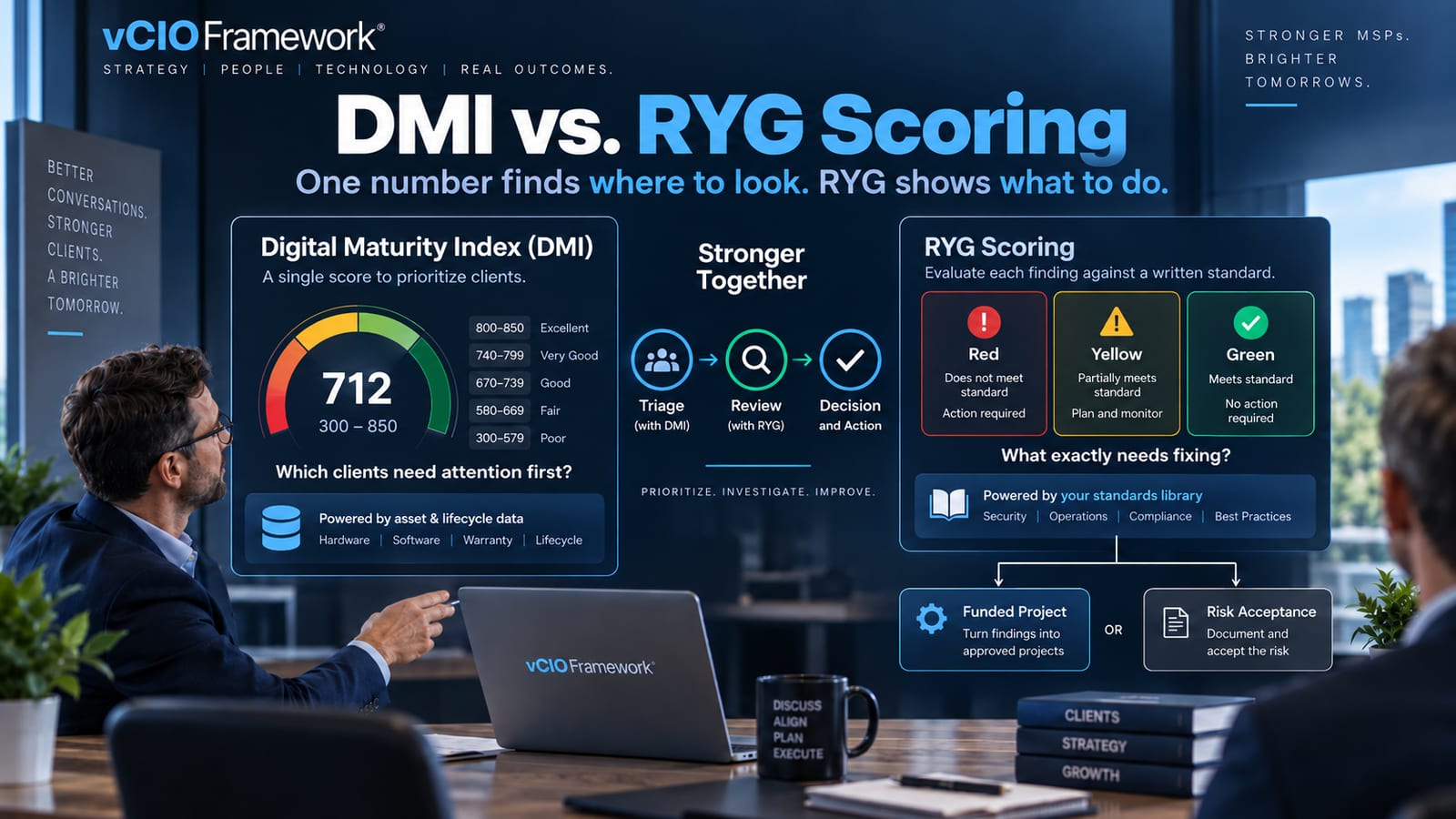
Technical Health (25%) - scores the client environment against the Standards Library: patch compliance rate, backup success rate, endpoint health, open critical vulnerabilities, and hardware lifecycle status. A technically unhealthy client is either accumulating risk that will eventually become an incident, or they are noticing that their technology posture is not improving despite paying for managed services. If you use ScalePad, see how its Digital Maturity Index compares in DMI vs. RYG scoring.
Relationship Health (25%) - scores the quality and depth of the human relationship: executive engagement in reviews, NPS or satisfaction score, response rate to communications, champion stability (has the key internal contact changed?), and escalation frequency. Relationship health is the most predictive single dimension for near-term churn. A deteriorating relationship score is almost always an early churn signal.
Financial Health (20%) - scores the commercial relationship: MRR trend (growing, flat, or declining), roadmap adoption rate (what percentage of approved roadmap items are being funded), and contract utilization. Declining MRR and low roadmap adoption are signs that the client is either dissatisfied with value delivered or financially stressed - both increase churn risk.
Security and Compliance (15%) - scores the client's exposure to security and regulatory risk: open security gaps from the Standards Library, outstanding risk acceptance waivers, compliance deadline proximity, and security incident history. A client with unresolved security risk and no active remediation plan is accumulating liability that will eventually force a difficult conversation - either with you or with a replacement MSP.
Strategic Alignment (15%) - scores how well the technology roadmap is connected to the client's business direction: whether the client has an approved roadmap, whether the roadmap was reviewed in the last review cycle, and whether the vCIO has documented the client's top three business priorities. Low strategic alignment means the client does not see the MSP as a business partner - they see a vendor.
Red, Yellow, Green Thresholds
Defining the scoring bands for each dimension
Green (75-100): Client is engaged, technically healthy, commercially active, and strategically aligned. Standard TBR cadence. Focus on roadmap progression and deepening executive relationships.
Yellow (40-74): One or more dimensions showing weakness. The client is not in immediate danger but the trajectory warrants attention. Allocate extra prep time to flagged dimensions in the next TBR. Identify the root cause of the yellow score and address it before the next review cycle.
Red (0-39): Immediate intervention required. A red health score means the account is at meaningful churn risk. Do not wait for the next scheduled TBR. Initiate an executive escalation call within two weeks.
Automatic Escalation Triggers
Certain conditions force a RED designation regardless of the overall score. These are non-negotiable escalation triggers:
No executive meeting in two or more consecutive quarters. If the client's leadership has been absent from TBRs for six months, the strategic relationship has atrophied and the MSP is operating purely as a vendor. Escalate immediately.
NPS below 30. A Net Promoter Score below 30 from any client is a distress signal. The client is actively dissatisfied and is either already talking to competitors or will be soon.
Champion departure. When the primary internal contact who advocated for the MSP leaves the company, the relationship resets. The incoming contact has no loyalty and will evaluate the MSP from scratch. This is a window of vulnerability that requires immediate action.
Declining MRR for two or more consecutive months. Sequential MRR decline is not a billing anomaly - it is a signal that the client is reducing scope, which often precedes a full exit.
Security incident unresolved beyond 30 days. An open, unresolved security incident after 30 days represents both a client risk and an MSP liability. It also signals that something is broken in the remediation process, which the client will notice.
Roadmap adoption below 30% with no EBR in 12 months. A client who is not funding roadmap items and has not had an executive-level review in a year has effectively disengaged from the strategic relationship. They are paying for managed services and nothing more - and they will eventually price-shop the managed services.
How to Run a Monthly Health Review
The health review is a 30-minute internal process, not a client-facing meeting. Once per month, the vCIO or account leadership team reviews the scorecard for every Tier A and Tier B client.
The review covers three questions for each account: has the score changed since last month, and in which direction? Are any automatic escalation triggers active? What specific action does the current score require before the next TBR?
Document the review output. Health scores that are not trended over time lose most of their diagnostic value. A client whose score has moved from 78 to 62 to 51 over three months is in a different situation than a client sitting at a stable 55. The trend is the signal.
How Health Scores Change TBR Preparation
Using the score to prioritize agenda items
The health score drives differentiated TBR preparation rather than a one-size-fits-all approach.
Green accounts: Standard TBR preparation. Review the scorecard, update the roadmap, prepare one or two strategic initiatives relevant to the client's current business priorities.
Yellow accounts: Allocate additional preparation time to the flagged dimension. If relationship health is yellow, review the last six months of meeting notes and identify what shifted. If financial health is yellow, review MRR trend and roadmap adoption rate before the meeting and prepare a value demonstration narrative. The TBR agenda should address the yellow dimension directly.
Red accounts: Do not walk into a TBR without first running an executive escalation call. The escalation call is a private conversation between MSP leadership and the client's executive sponsor. Its purpose is to surface whatever is driving the red score before it becomes a formal complaint or a non-renewal. The TBR itself should then be restructured around addressing the root cause.
The Retention Gap Between Levels
Industry data consistently shows that client churn at Level 1 and 2 MSPs runs 15-25% annually. At Level 4 and 5 MSPs operating structured health scoring and defined escalation protocols, annual churn typically runs 5-8%. That retention gap, applied to a $500,000 MRR book of business, is the difference between losing $75,000-$125,000 in MRR per year and losing $25,000-$40,000.
The health score does not prevent churn on its own. It surfaces the signals early enough for intervention to matter.
The free vCIO Readiness Assessment includes a health scoring module that shows you exactly where your current client monitoring has gaps. The vCIO Framework document library includes the full Client Health Scorecard template and escalation protocol.
Frequently Asked Questions
How often should client health scores be updated?
Technical dimensions (Standards Library alignment, security posture, infrastructure age) should be reviewed monthly or after any significant change to the environment. Relationship dimensions (TBR engagement, escalation frequency, budget conversation tone) should be reviewed after every client interaction. The aggregate score should be reviewed in a monthly internal account management meeting where any Red accounts get explicit escalation plans.
What should trigger an escalation when a health score drops?
Any single dimension dropping to Red warrants a proactive outreach within 5 business days - not a scheduled TBR, but a direct call or meeting specifically about that signal. An aggregate score dropping from Green to Yellow triggers a review of the TBR cadence and an internal discussion about whether the engagement model needs to change. An aggregate Red score triggers escalation to senior account leadership and a formal recovery plan within 30 days.
Can health scoring replace regular TBRs?
No. Health scoring is an early warning system that feeds into TBR preparation. It tells you which clients need the most attention before the meeting and which agenda items to prioritize when you get there. A client with a declining relationship score needs a different TBR than one with strong engagement. The score shapes the conversation - it does not replace it.
Health scoring feeds directly into your TBR and account management cadence. See how it connects to silent churn detection and the standardized account management process that acts on the signals.
From the vCIO Framework
Score Your vCIO Program
Download the vCIO Framework and get your Red/Yellow/Green methodology in one business day.
Get the Framework