Why Selling Fear After a Vendor Breach Backfires on MSPs
N-able and Kaseya proved the risk is real. Here is why turning that fear into a sales pitch costs MSPs more trust than it wins in new deals.

On July 31, 2026, attackers began exploiting an authentication bypass in N-able's N-central RMM platform. N-able shipped a hotfix on August 2 - and it did not fully close the hole. A second CVE followed within days, CISA added the flaw to its Known Exploited Vulnerabilities catalog, and federal agencies were given until August 6 to patch. Attackers who got in used the platform's own Take Control feature to reach managed endpoints and planted Cloudflare tunnels to keep access even after the N-central server itself was locked down.
Within about 48 hours, MSP inboxes everywhere had a different kind of message: vendors and consultants pointing at the headline and asking whether it was finally time to switch RMM platforms. That reflex - turning a real vulnerability into a sales trigger - is what this post is about. Not whether the N-able flaw was serious. It was. The question is what an MSP does with that fear, and why weaponizing it against your own clients or a competitor's clients is a worse long-term strategy than most MSPs realize.
The Vulnerability Was Real - That Is Exactly the Point
N-able N-central's CVE-2026-18556 and its follow-up, CVE-2026-18577, each scored a CVSS of 8.2. Both allowed an unauthenticated attacker to gain administrative access to the RMM console itself - the single tool with standing remote access to every managed endpoint across every client an MSP serves. CISA's Known Exploited Vulnerabilities catalog confirmed active exploitation before most MSPs had even read the advisory.
This is not a new category of risk. In July 2021, a REvil-affiliated group exploited a zero-day in Kaseya VSA and pushed ransomware through the supply chain to roughly 1,500 downstream businesses in a single weekend - almost entirely because Kaseya VSA was, like N-central, a tool with privileged access to every client environment it touched. Different vendor, different year, same underlying lesson: RMM and PSA platforms are the highest-leverage single point of failure in an MSP's stack, because they are built to have god-mode access by design.
Why "we patched fast" is not the same as "we were never at risk"
N-able's first hotfix went out within two days of active exploitation starting - a reasonable response by industry standards. It still was not enough; the fix left a second path open, and that gap is what CVE-2026-18577 covers. This is not a knock on N-able specifically. It is a demonstration that even a fast, competent vendor response can miss something on the first try, in software this complex, under this much time pressure. Every RMM and PSA platform on the market has had CVEs. The tool is not the differentiator. How an MSP manages vendor risk is.
Why "Switch Now or You Are Next" Is the Wrong Pitch
Within days of the N-able disclosure, some corners of the channel ran exactly the playbook you would expect: urgent emails implying that staying on the affected platform is negligence, that competitors are already migrating, that the prospect has a narrow window before disaster strikes. It works often enough that people keep doing it. It is still a bad strategy, for three specific reasons.
It sells a decision, not an assessment. A single CVE, however serious, is one data point. A defensible platform decision requires looking at patch cadence history, MFA enforcement, incident response track record, and how the vendor communicated during the incident - not a 72-hour panic window triggered by a headline.
It treats the RMM as the whole risk surface. Switching platforms does not eliminate vendor risk - it just changes which vendor you are trusting, and resets the clock on that vendor's own eventual CVE. Nothing about a rushed migration under fear pressure improves an MSP's actual security posture unless the underlying gaps - patch discipline, access controls, monitoring - get fixed too.
It teaches the client to evaluate you on fear, not value. A prospect who signs because they were scared evaluates every future interaction the same way. We have written before about how commoditization is the real risk behind silent churn - and fear-based selling is commoditization's twin. If the sale was won on panic, the next louder panic pitch from a competitor wins it right back.
What Real Risk Advisory Looks Like Instead
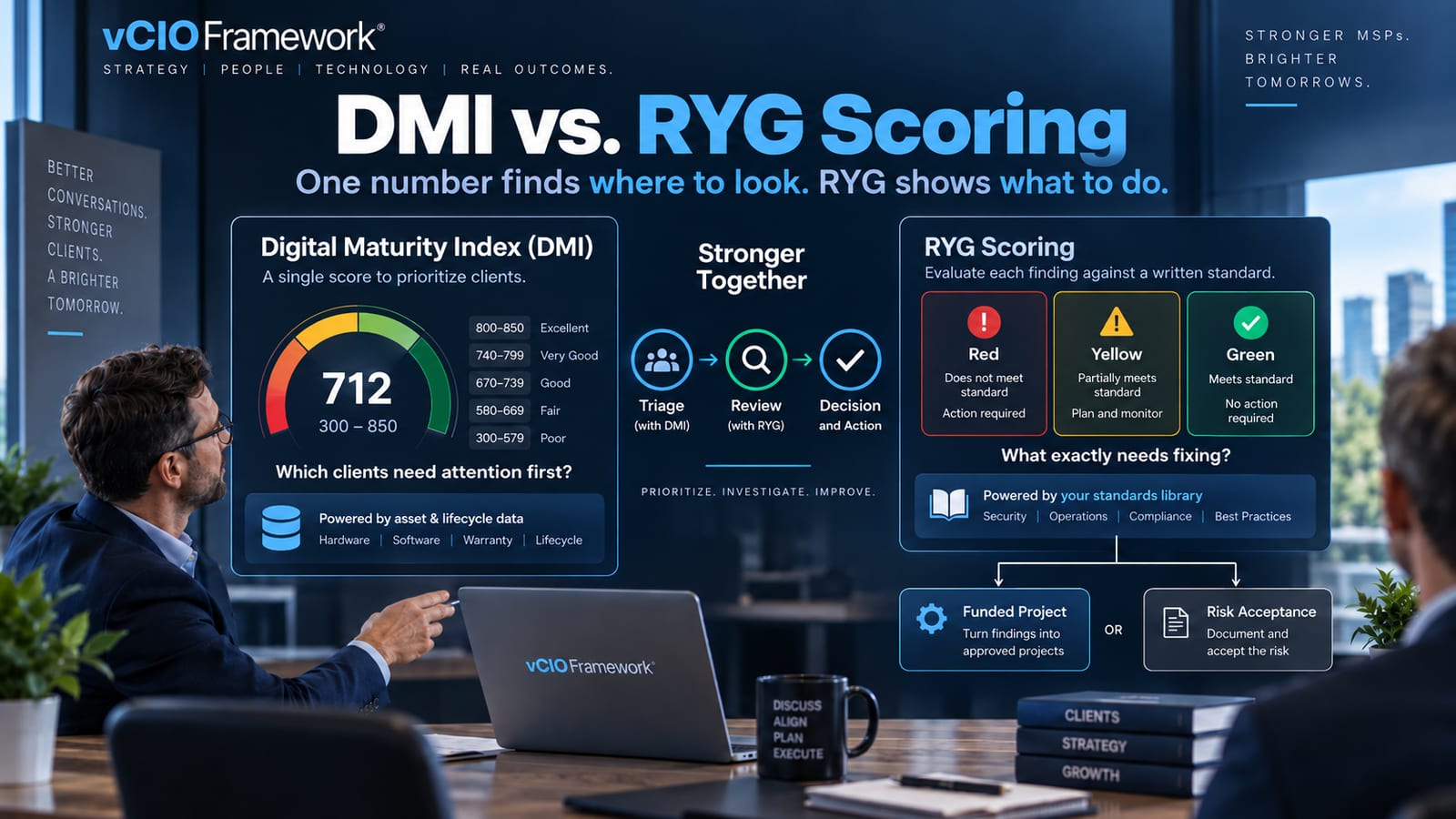
Vendor and tooling risk should never be a fire drill. It should be a standing, scored line item inside the client's account health picture - the same Red, Yellow, Green discipline that governs every other part of a structured client health score. When a CVE like N-able's breaks, the right move is not an emergency email campaign. It is documenting plainly what was assessed, what was patched, and what residual risk remains - on whatever cadence the MSP already uses to keep clients informed.
A client who has watched their MSP calmly document and remediate three prior findings does not need to be frightened into trusting the fourth one is handled correctly. They already know it will be. That is the entire difference between advisory and salesmanship: one is built on a track record, the other on a headline.
The Trust Math: Fear Sells Once, Advisory Retains for Years
Industry data suggests annual client churn at MSPs running unstructured, reactive account management falls in the 15-25% range, while MSPs operating structured health scoring typically hold churn to 5-8%. Fear-based selling does not change which bucket an MSP falls into - if anything, it reinforces the first one, because it trains the client relationship to run on urgency instead of process. A deal closed on fear has to be re-won every time a scarier pitch shows up. A deal retained through documented, calm risk management compounds instead: the client sees the same rigor applied consistently, and the relationship gets harder to dislodge over time, not easier to panic out of. That retained relationship is exactly the revenue already sitting in your client base - protecting it is cheaper than replacing it with a client who was won on fear and will leave the same way.
Building This Into Your Own Practice
None of this means MSPs should stay quiet about vulnerabilities like the N-able flaw. Silence is its own failure. The distinction is between documented risk communication - what was found, what it means for this specific environment, what is being done about it, by when - and a manufactured-urgency pitch designed to close a deal before the prospect has time to think. The vCIO Framework includes the Security Posture module and Red/Yellow/Green scoring rubric that makes vendor and tooling risk a routine, documented part of every review cycle instead of a once-a-year scramble. If you want to see where your own account reviews stand on this before the next headline hits, the free vCIO assessment scores your practice across 5 key areas in about 8 minutes.
Frequently Asked Questions
Does this mean MSPs should not tell clients about vulnerabilities like the N-able N-central flaw?
No - the opposite. Proactive disclosure and remediation communication is core to the vCIO role. The distinction this post makes is between documented risk communication (what was found, what it means for this environment, what is being done, by when) and a manufactured-urgency sales pitch built to close a deal on panic before the prospect has time to evaluate anything properly.
How should an MSP talk to a client about a vendor vulnerability without fearmongering?
Bring it into the existing Red/Yellow/Green account health picture and the next scheduled account review, not an emergency out-of-cycle campaign. State plainly what was assessed, whether the client's environment was exposed, what remediation happened and when, and what residual risk - if any - remains. Calm, specific, and documented beats urgent and vague every time.
Is switching RMM or PSA vendors ever the right move after a CVE like this?
Sometimes - but it should follow a structured vendor risk evaluation covering patch cadence history, MFA enforcement, and incident response track record, not a 72-hour panic decision. Every major RMM and PSA platform has had CVEs at some point. The question is not which vendor has a perfect record. None do. The question is which vendor - and which MSP managing that vendor relationship - handles the inevitable disclosure well.
From the vCIO Framework
Score Your vCIO Program
Download the vCIO Framework and get your Red/Yellow/Green methodology in one business day.
Get the Framework