The vCIO Playbook: Standardizing Your Account Management
Consistency is the key to scaling your MSP. Learn how to standardize your vCIO services and account management process across your entire team.

Ask five account managers at your MSP how they run a client review and you'll get five different answers. One does a deep technical walkthrough. Another focuses on upcoming renewals. A third spends most of the time on relationship-building. The fourth follows whatever format the client seems to prefer. The fifth hasn't had a meaningful review with two of their accounts in six months.
This is the account management consistency problem - and it's one of the most expensive operational failures an MSP can have.
Why Inconsistency Kills Scale
When your account management process depends on individual talent rather than a defined system, two things happen. First, your best account manager becomes a single point of failure - if they leave, the relationships they've built walk out with them. Second, you can't diagnose what's working. If every AM runs their accounts differently, you have no baseline to improve against.
Scaling an MSP requires turning repeatable processes into institutional knowledge. Account management is no different from service delivery in this regard. You wouldn't let technicians resolve tickets however they feel like it. The same discipline needs to apply to client strategy.
The hidden cost of AM dependency
When a top-performing account manager leaves an MSP, the business typically loses 30-50% of that AM's book within 12 months. Not because the service quality drops - it usually doesn't. But because the client relationship was personal rather than institutional. The client trusted the individual, not the process. Without a documented engagement model, there is nothing for the new AM to inherit except a contact list and some hope.
Systematizing account management is not about removing the human element. It is about ensuring that when a great account manager does leave, the client experience remains consistent because the process is what drives outcomes - not the personality delivering it.
What Standardization Actually Means
Standardizing your vCIO process doesn't mean scripting every conversation or removing the human element from client relationships. It means defining the non-negotiables: which clients get reviewed how often, what gets covered in each review type, how client health is measured and documented, what triggers an escalation, and how opportunities get identified and handed off to sales.
Within that structure, individual account managers still bring their own style and judgment. But the process ensures that no client falls through the cracks and no review is left to improvisation.
The five non-negotiables in a standardized vCIO process
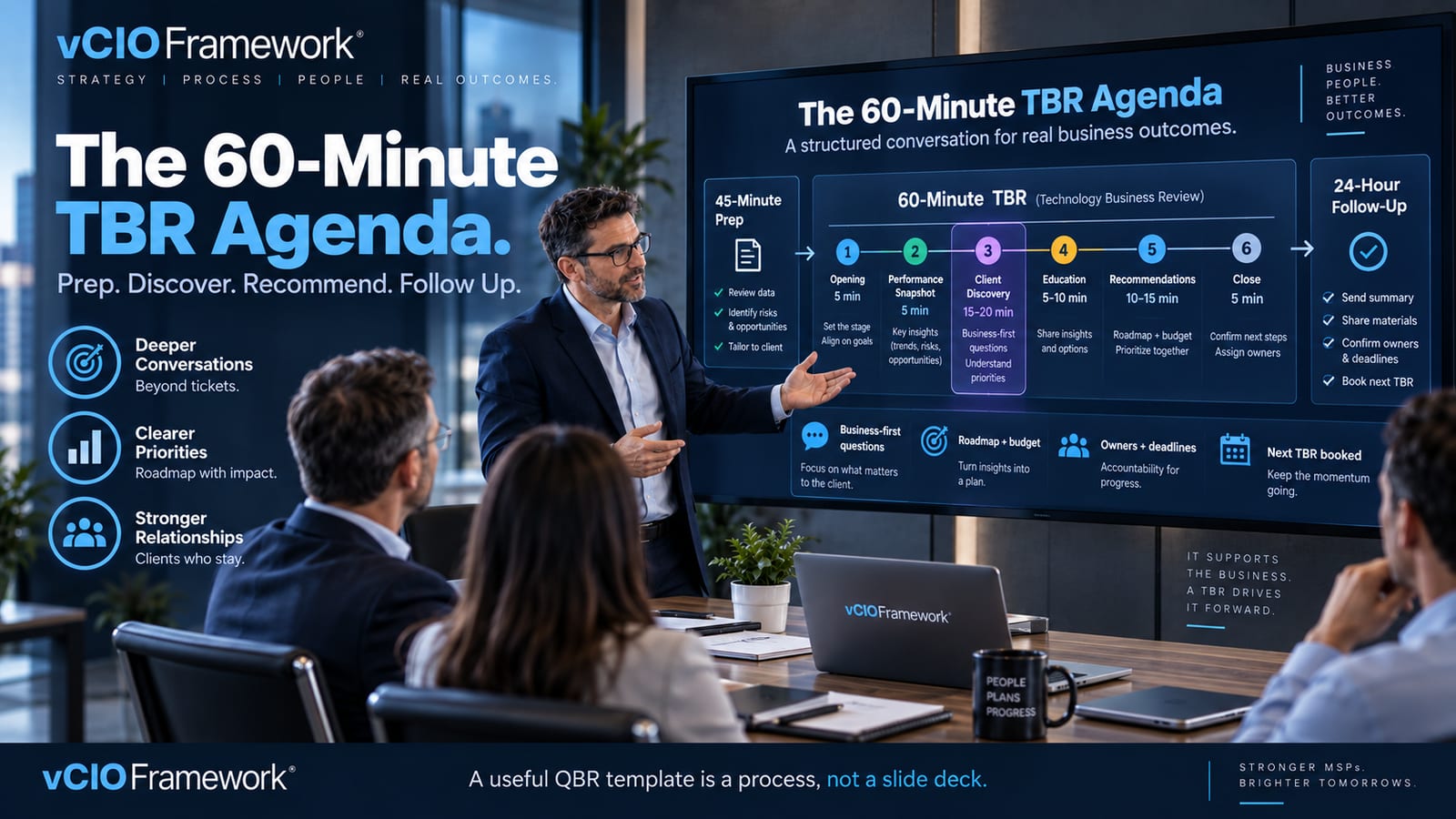
Every account management system that scales successfully defines the same five things. First, a client tiering model that determines engagement frequency - not every client gets the same time, and pretending otherwise burns out your best people. Second, a pre-meeting preparation checklist that covers health score update, open roadmap items, Standards Library gaps, and any business events flagged since the last review. Third, a meeting agenda template that cannot be overridden - the structure is fixed, the conversation within it is not. Fourth, a post-meeting documentation standard that captures commitments, risks, and next steps in a form that any AM can pick up. Fifth, an escalation trigger definition - the specific client health signals that require manager involvement.
MSPs that define all five operate with a fundamentally different level of account stability than those that leave any one of them to individual discretion. ConnectWise's MSP benchmark research consistently shows that process-driven MSPs outperform relationship-driven MSPs on both retention and margin as they scale past $2M MRR.
The Tiering Foundation
Standardization starts with tiering. Not every client deserves the same level of attention, and pretending otherwise is how account managers burn out. A clear tiering model - based on revenue, complexity, strategic potential, and relationship health - tells your team where to invest their time and what level of engagement each client should receive.
Once clients are tiered, you can define review cadences, deliverable expectations, and escalation thresholds for each tier. That structure is what makes account management scalable instead of heroic.
Tier A, B, and C in practice
In the vCIO Framework, clients are segmented into three tiers. Tier A - Always Engaged - are your highest-value accounts by revenue, complexity, and strategic relationship depth. They receive quarterly TBRs, annual EBRs, and proactive outreach between reviews. Tier B - Betterment Focused - are growth accounts with strong potential that have not yet reached strategic depth. They receive semi-annual TBRs and structured roadmap reviews. Tier C - Core Consistent - are stable, lower-complexity accounts. They receive annual reviews with a mid-year check-in and reactive engagement between reviews.
The tiering criteria should be reviewed quarterly. A Tier C client who has just been acquired or hired a new IT director may need to move to Tier B immediately. A Tier A client who has reduced headcount significantly may need to move down. Tiering is a live classification, not an annual exercise.
Documentation Is the System
A standardized process only works if it's written down and followed consistently. Every client review should produce documented outputs: what was discussed, what was agreed, what the client's top three priorities are, what risks are open, and what's on the roadmap for the next 12 months.
That documentation isn't bureaucracy - it's institutional memory. It's what lets a new account manager pick up a relationship without starting from zero. It's what lets you look across your entire client base and identify patterns in risk, opportunity, and churn indicators before they become problems.
The MSPs that scale past $5M in MRR without falling apart are almost always the ones that treated account management as a system first and a relationship function second. The relationships still matter. But the system is what makes them sustainable. See how this connects to the difference between a vCIO and a traditional account manager, and explore the client health scoring model that makes proactive account management measurable.
Frequently Asked Questions
How many accounts can one vCIO or account manager handle?
With a structured process and tiered engagement model, one account manager can effectively manage 20-30 Tier A clients, 40-60 Tier B clients, or 80-100 Tier C clients. Without a process, those numbers drop by 30-40% because each client interaction requires rebuilding context from scratch instead of picking up from a documented record.
What is the difference between a vCIO and an account manager at an MSP?
An account manager focuses on relationship maintenance, renewals, and client satisfaction within the current service scope. A vCIO focuses on strategic advisory - translating technology gaps into business risk, driving roadmap decisions, and positioning the MSP as a forward-looking partner rather than a reactive vendor. Many MSPs use the titles interchangeably, which creates role confusion and underdelivers on both functions. See the full breakdown of vCIO vs account manager for a detailed comparison.
How do you measure account management effectiveness?
The three leading indicators are review completion rate (percentage of clients who received their scheduled review in the quarter), roadmap coverage (percentage of active clients with a documented 12-month roadmap), and health score trend (whether the aggregate client health score across your book is improving, stable, or declining). Lagging indicators are renewal rate, NPS, and project revenue per client per year.
Once TBR cadence is standardized, the next step for Tier A accounts is layering in a proper Executive Business Review - a different meeting, for a different audience, with a different outcome.
From the vCIO Framework
Get the vCIO Framework
14 modules, TBR/EBR templates, AI Advisory playbook, and RYG scoring rubrics. Free download. No lock-in.
Download Free