Account Manager vs. vCIO: MSP Roles and Responsibilities
Most MSPs use the titles interchangeably. Here are the responsibilities, success metrics and pricing that separate an account manager from a vCIO.

Walk into most MSPs and ask who handles the client relationship. You will get one of three answers: the owner, the sales rep who closed the deal, or someone with "account manager" in their title who spends most of their time on renewals and escalations. In a handful of more mature MSPs, you will hear "our vCIO." In practice, the person doing the work is usually a hybrid of all of these - and that ambiguity is expensive.
Clarifying the difference between a vCIO and an account manager is not an organizational chart exercise. It is a revenue decision. The two roles produce different client outcomes, command different pricing, and create different retention dynamics. Conflating them is the single most common reason MSP advisory practices fail to generate the MRR they should.
What an Account Manager Actually Does
Scope, outputs, and success metrics
The account manager role in an MSP context is fundamentally relationship-maintenance. A good account manager ensures the client is satisfied with service delivery, catches issues before they become escalations, manages renewals, and looks for expansion opportunities - usually by responding to client-initiated requests rather than proactively identifying gaps.
Account managers are operationally oriented. Their success metrics are client satisfaction scores, renewal rates, and response times. They are the connective tissue between the client and the MSP's delivery team. This role is essential. Without it, clients feel neglected and churn silently.
But the account manager role has a ceiling. It is reactive by design. The AM responds to what the client brings to the conversation. When nothing is broken and renewals are smooth, there is little structural pressure to go deeper. Technology gaps go undocumented. Roadmaps do not get built. Risk accumulates invisibly until an incident forces the conversation.
What a vCIO Actually Does
Scope, outputs, and success metrics
The vCIO role is strategically oriented. Where the account manager maintains the relationship, the vCIO builds the plan. A functioning vCIO practice does five things consistently that account management does not:
First, it scores the client environment across a standardized set of dimensions - security posture, technology lifecycle, compliance alignment, BCDR readiness, and business continuity - and produces a documented Red/Yellow/Green assessment that the client can see and act on.
Second, it builds and maintains a 12-36 month technology roadmap that connects infrastructure decisions to business objectives. The roadmap is not a wish list - it is a prioritized, budgeted plan that the client signs off on and references in every TBR.
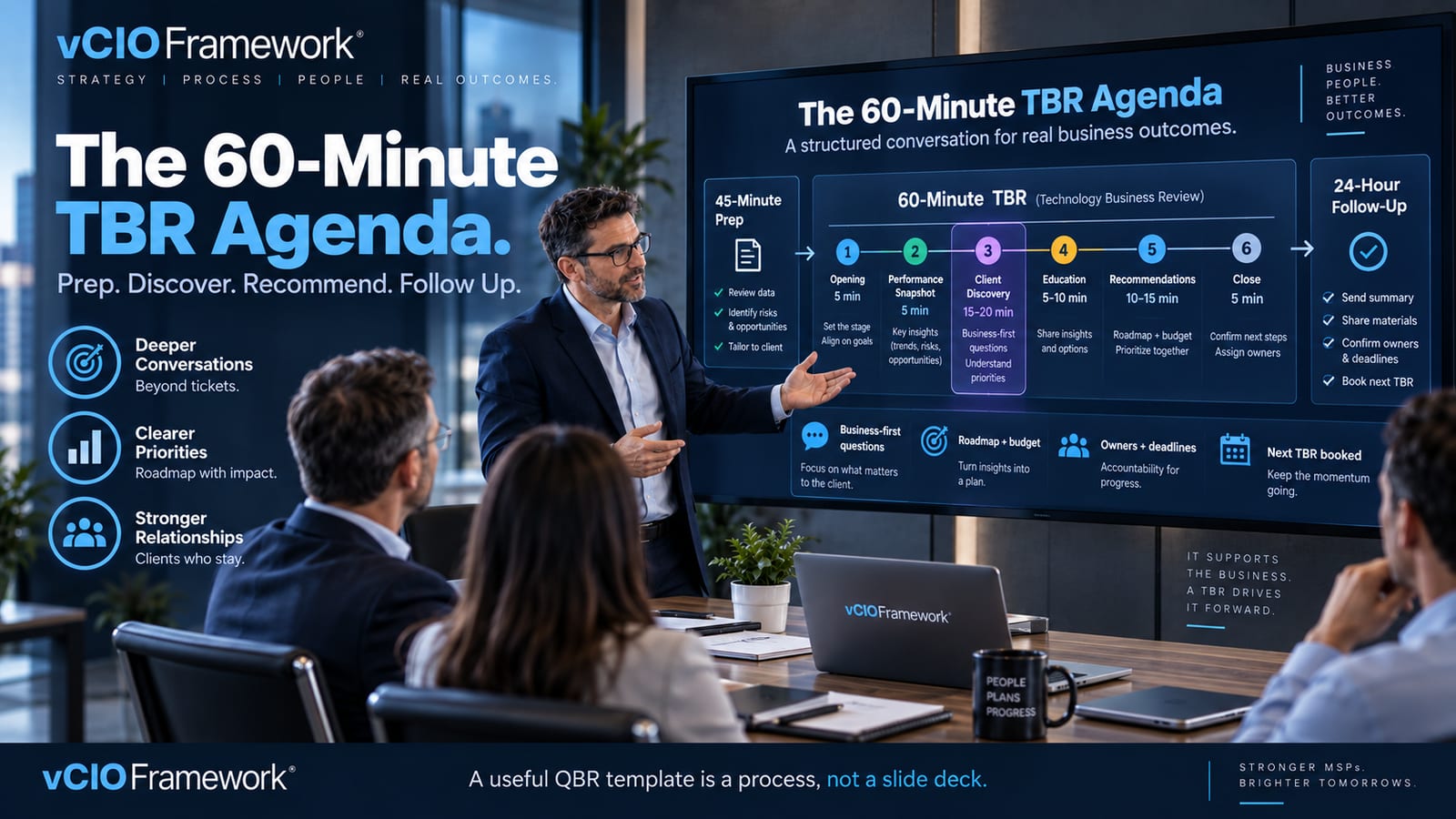
Third, it runs structured Technology Business Reviews on a defined cadence - quarterly for Tier A clients, semi-annually for Tier B - with a consistent agenda that covers roadmap progress, risk register updates, and strategic initiatives. Not check-in calls. Structured reviews with documented outputs.
Fourth, it proactively identifies revenue opportunities - hardware refresh cycles coming due, security gaps that require new tooling, compliance requirements the client has not yet addressed - before the client asks. The vCIO's job is to surface these gaps and present a plan, not to wait for a ticket.
Fifth, it positions the MSP as a strategic partner rather than a vendor. The client's CEO or CFO engages with the vCIO at a business level, not just a technology level. This is the relationship dynamic that makes MSPs defensible against commoditization.
The TAM Middle Ground
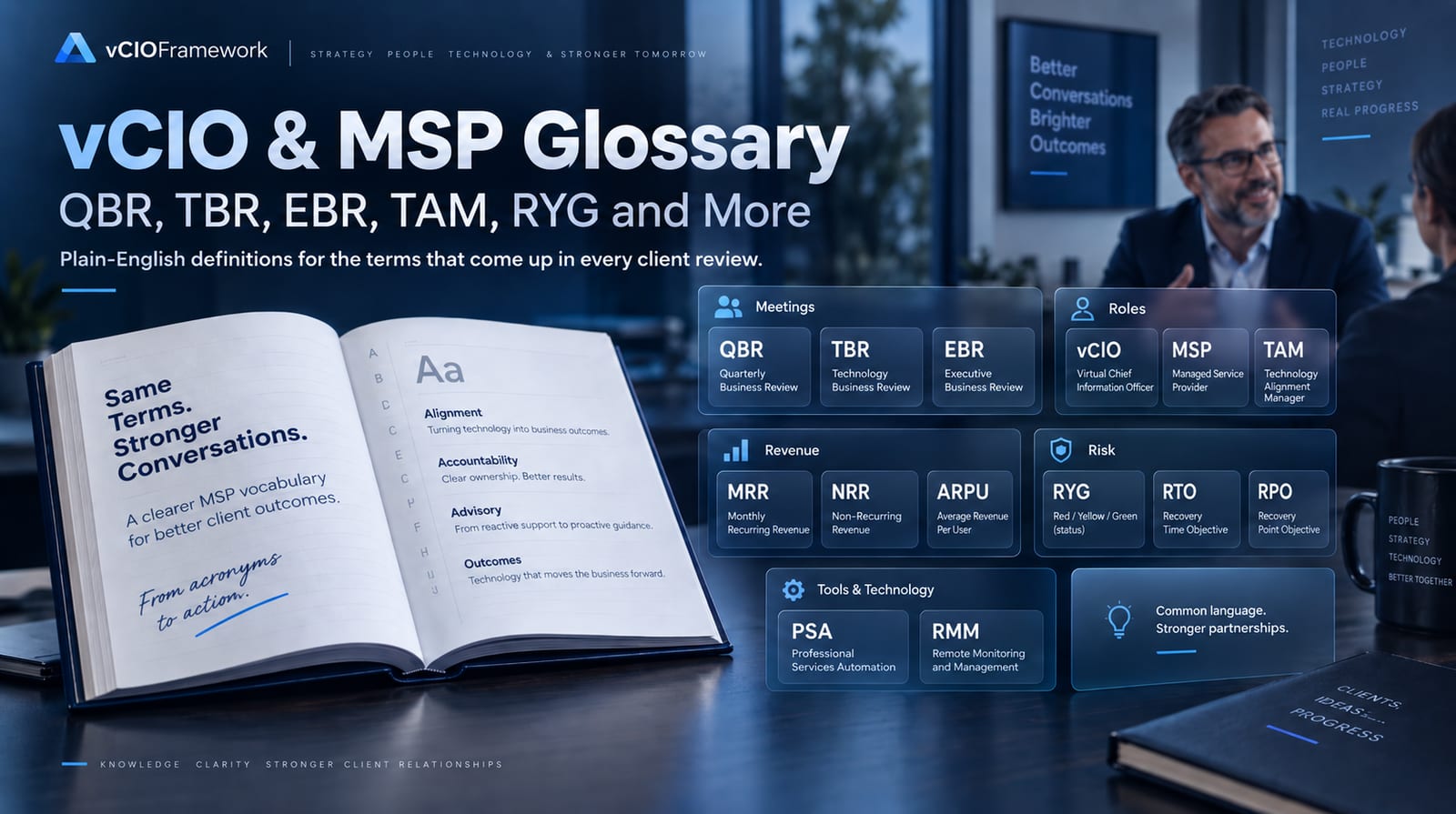
Many MSPs are building a hybrid role called the Technology Alignment Manager (TAM) that sits between traditional account management and full vCIO delivery. The TAM handles the operational relationship and conducts structured alignment reviews, but stops short of full business strategy advisory.
The TAM model works well for Tier B and Tier C clients where the engagement intensity does not justify a full vCIO practice. The key is that the TAM still operates from a structured framework - standardized scoring, documented roadmaps, defined review cadence - rather than improvising the engagement based on whatever the client raises.
Why the Confusion Is Expensive
What mixing the roles costs in revenue and retention
ConnectWise MSP benchmark data shows that MSPs with clearly defined strategic advisory roles - separate from account management - average 31% higher client lifetime value than those where the roles are blended. The difference is not in the relationships. It is in the structure of the conversations those relationships produce.
When MSPs treat vCIO and account manager as the same role, several things happen. The strategic work crowds out the relationship work and vice versa - the person doing both ends up doing neither well. Pricing is impossible to defend because the role is not clearly defined. And the client experience becomes inconsistent: some clients get strategic advisory, others get glorified account management, and there is no structure to determine which is which.
Industry data from the Datto 2024 State of the MSP report shows that improving customer experience is a top strategic priority for 47% of MSPs. The path to that improvement is almost always role clarity, not technology investment. When clients know what to expect from each interaction - operational support from the account team, strategic advisory from the vCIO - satisfaction and retention both improve.
How to Separate the Roles in Practice
The practical starting point is defining what each role produces. The account manager produces client satisfaction, clean renewals, and rapid escalation handling. The vCIO produces scored assessments, technology roadmaps, TBR documentation, and a risk register. These are different deliverables that require different skills and different time allocation.
For smaller MSPs where one person fills both roles, the solution is structured time allocation and a documented methodology. Reserve a defined percentage of that person's time each month for vCIO-mode work: running assessments, updating roadmaps, preparing TBR agendas. The methodology tells them what to do with that time so it does not get consumed by reactive work.
The vCIO Framework v1.15 is built specifically for this transition. The 14-module structure gives whoever is doing vCIO work a defined scope. The Red/Yellow/Green rubric tells them what to score. The TBR agenda templates tell them how to run the review. The discovery question bank tells them what to ask. The framework is what converts an account manager with good intentions into a functioning vCIO practice.
Download the framework at vcioframework.com or run the vCIO Framework to see exactly where your current practice has gaps.
Frequently Asked Questions
Can one person do both the vCIO and account manager role?
In a small MSP (under $1M MRR), one person often handles both. The risk is that the account management function - renewals, satisfaction, day-to-day relationship - crowds out the strategic advisory function. As the MSP scales, separating the roles pays for itself. The account manager handles the operational relationship. The vCIO handles the strategic relationship. Neither role dilutes the other.
What qualifications does a vCIO need at an MSP?
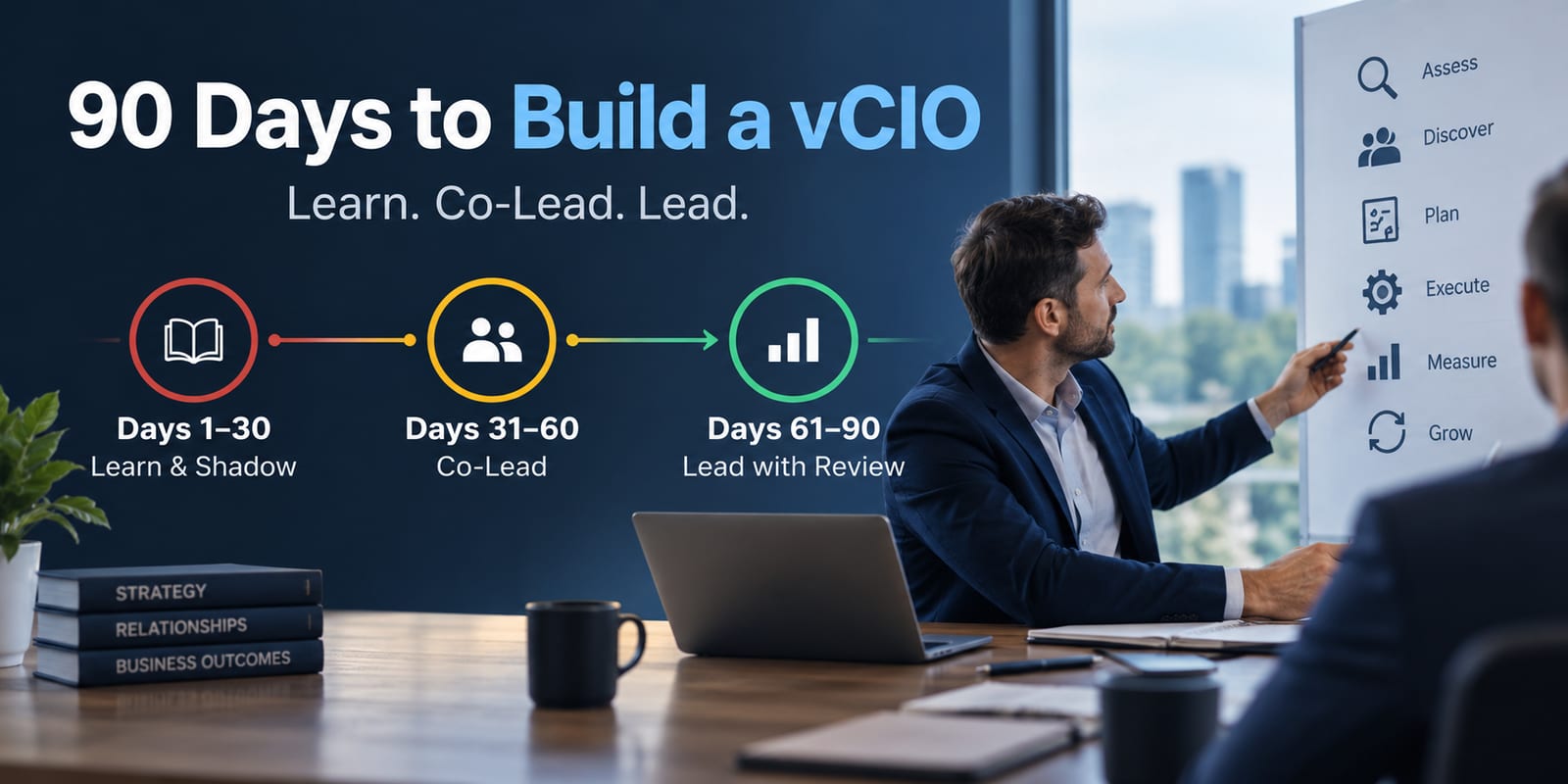
A vCIO does not need to be the most technical person in the room - that is the TAM's job. They need business acumen, communication skills, and deep familiarity with the client's industry and operations. Many effective MSP vCIOs come from a business analyst or project management background rather than a purely technical one. The credential that matters most is the client's trust, which is built through consistent, accurate advisory - not certifications. For how to develop those skills in a new vCIO, see our 90-day vCIO training plan.
How do you introduce a vCIO role to existing clients?
Frame it as an upgrade in how you serve them strategically, not a change in who handles their tickets. Present the vCIO at the next TBR as the client's dedicated technology advisor. Give them a tangible deliverable in that first meeting - a technology roadmap update, a risk score, or a Standards Library gap report. The introduction is less important than the value produced in the first 60 days.
Once you have the roles defined, the next question is process. See the vCIO account management playbook for how to standardize delivery across both roles, and the vCIO pricing guide for how to charge for the differentiation.
From the vCIO Framework
Get the vCIO Framework
14 modules, TBR/EBR templates, AI Advisory playbook, and RYG scoring rubrics. Free download. No lock-in.
Download Free