How to Run an MSP QBR (TBR) That Actually Generates Revenue
Most MSP QBRs are glorified status calls. Here is the TBR agenda and scoring methodology that turns a quarterly review into a revenue conversation.

The Technology Business Review - TBR, the meeting most MSPs call a QBR - is the highest-leverage client conversation an MSP can have. Done well, a single 90-minute TBR can uncover $30,000-$80,000 in addressable project revenue, document risk exposure that justifies security stack upgrades, and produce the kind of strategic alignment that makes a client genuinely difficult to replace. Done poorly, it is a status update call that nobody looked forward to and everyone forgot two days later.
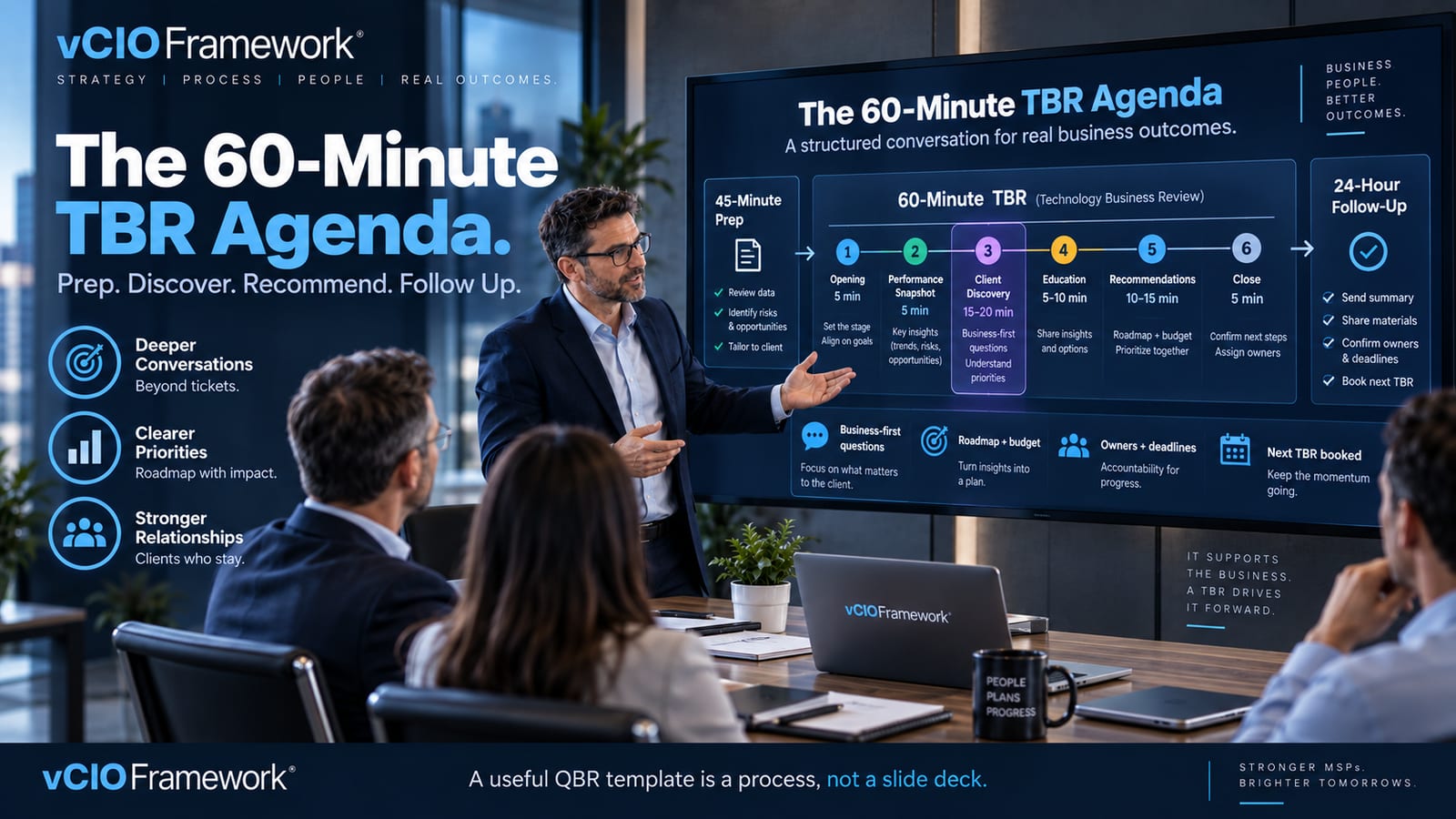
Most MSP TBRs are the second kind. Not because the people running them lack expertise, but because they lack structure. The conversation follows wherever the client takes it. There is no standard agenda. There is no pre-work. There is no documented output. The MSP leaves knowing roughly how the client feels about service quality, which is useful, but leaves behind every strategic opportunity the meeting could have surfaced. Our free QBR (TBR) template gives you that structure: a prep protocol, a six-section agenda, and a follow-up process.
This guide covers the mechanics of a TBR that actually moves the needle.
Before the Meeting: The Work That Makes the Meeting
According to Datto's Global State of the MSP Report, MSPs that conduct structured business reviews at least quarterly report 30% higher client retention than those that meet reactively. The preparation work - health scoring, Standards Library gap analysis, roadmap update - is what makes that retention difference real.
The quality of a TBR is determined almost entirely by the preparation that happens before anyone sits down. A TBR with no pre-work is a conversation. A TBR with structured pre-work is a strategic review.
Two weeks before the TBR, your team should complete a current-state assessment of the client environment across five dimensions: security posture, technology lifecycle, BCDR readiness, compliance alignment, and vendor/agreement health. Each dimension gets a Red/Yellow/Green score based on defined criteria. Red means immediate action or documented liability. Yellow means needs attention or inconsistent practice. Green means solid and systemized.
This scoring is not optional background work. It is the agenda. The RYG assessment tells you exactly what the meeting needs to cover and in what order. Every RED item is a conversation starter. Every YELLOW is a roadmap candidate. Every GREEN is a retention anchor - evidence that your MSP is delivering outcomes, not just responding to tickets.
One week before, send the client a brief pre-read that includes three things: a one-page summary of where their technology stands relative to their business goals, the top two or three items you plan to discuss in depth, and any decisions you need them prepared to make. Clients who come to a TBR prepared have a materially different conversation than clients who arrive cold.
The Agenda Structure That Works
A 90-minute TBR with a business owner or leadership team should follow a consistent five-section structure. Deviating from this structure is how TBRs drift back into status calls.
Section 1: Business Update (15 minutes)
This section is about the client's business, not their technology. What has changed in the last quarter? Are they hiring, restructuring, expanding to a new location, entering a new vertical, or planning an acquisition? Have their compliance requirements changed? Is there a new regulatory obligation on the horizon?
The vCIO's job here is to listen for technology implications, not to present. Every business change has a technology dimension. A new location means network infrastructure. A hiring surge means endpoint provisioning and identity management. A new compliance requirement means a gap assessment. The business update section is where you find the next year's roadmap items.
Section 2: Scorecard Review (20 minutes)
Present the RYG scorecard. Walk through each dimension - security, lifecycle, BCDR, compliance, vendor health - and give a plain-language explanation of the score. Do not lead with technology detail. Lead with business impact. A RED on BCDR is not "your backup success rate is below threshold." It is "if your primary system failed today, your business would be down for longer than your operations can absorb."
For each RED item, have a recommended action ready. For each YELLOW item, have a roadmap entry ready. For each GREEN item, briefly acknowledge it and move on. Clients do not need extended discussion of what is working - they need your attention on what is not. Presenting each RED item as three priced options converts better than a single proposal - see Good, Better, Best QBR recommendations.
Section 3: Roadmap Review (20 minutes)
Pull up the technology roadmap and review progress against the prior period's commitments. What was on the roadmap? What got done? What shifted? What is new based on the scorecard and the business update?
The roadmap should show 12-36 months of planned investment with rough budget estimates attached to each initiative. This is not a project list - it is a strategic plan. Clients who have a visible, maintained roadmap are dramatically less likely to feel surprised by technology costs, which is one of the leading causes of MSP client dissatisfaction and churn.
During this section, confirm the budget allocation for the next two quarters. Which roadmap items will be funded? Which will be deferred? Get explicit agreement. Document it. This documentation is what protects the MSP when a client later claims they "had no idea" a major project was coming.
Section 4: Strategic Initiatives (25 minutes)
This is the forward-looking section. Based on everything you have learned in sections one through three, present one to three strategic initiatives you believe the client should be thinking about in the next 12 months. These are not upsells - they are recommendations grounded in the client's business context and the scoring data.
Examples: If the business update revealed a hiring plan, a strategic initiative might be a cloud identity management consolidation that scales with headcount. If the scorecard showed a RED on AI advisory readiness and the client mentioned their competitors are adopting AI tools, a strategic initiative might be a structured AI readiness assessment. If a compliance deadline is approaching, the initiative is the remediation project with a timeline and budget estimate. For where AI fits in the vCIO's own review process, see AI for vCIOs.
Present each initiative in business terms first. Cost, timeline, and technical detail come after the client understands why it matters to their operation.
Section 5: Decisions and Next Steps (10 minutes)
Every TBR should end with documented decisions and committed next steps. Who is doing what, by when? Which roadmap items were approved? Which strategic initiatives will be scoped? What follow-up does the client expect from the MSP before the next review?
This section is where the TBR converts to revenue. Approved roadmap items become project scopes. Approved strategic initiatives become discovery engagements. Documented next steps become follow-up conversations with a committed timeline.
The Output: What Gets Documented
A TBR with no documentation is a conversation with a short half-life. Within two weeks, both sides will have different recollections of what was agreed. The documentation from a TBR is the institutional memory of the client relationship - and it is the evidence that justifies your vCIO pricing.
Every TBR should produce four documents: the updated RYG scorecard with notes on what changed and why, the updated roadmap with any new items, additions, or deferrals marked, a decisions log with explicit notes on what was approved, deferred, or declined, and a next steps list with owner and date for each item.
These documents live in your documentation platform and are referenced at every subsequent TBR. Over time, they build an evidence base of strategic advisory that is essentially impossible to replicate by a competitor who is starting from scratch.
Frequency and Client Tiering
Not every client should receive the same TBR cadence. Tier A clients - your highest-value, highest-complexity accounts - should have formal TBRs quarterly with monthly check-in touchpoints. Tier B clients warrant semi-annual formal reviews. Tier C clients may receive annual strategic reviews with ad-hoc touchpoints as needed.
The tiering drives the pricing. Tier A clients receiving quarterly TBRs with full pre-work and documentation are receiving a more intensive service that commands a higher vCIO monthly fee. Tier C clients receiving annual reviews are receiving a lighter engagement priced accordingly.
The Number That Changes the Conversation
Industry data consistently shows that MSPs running structured, scored TBRs on a defined cadence identify 30-50% more addressable revenue per client per year than MSPs running informal quarterly check-ins. The $50,000 annual opportunity per client that goes unidentified in an unstructured account management model is not hypothetical - it is the gap between a hardware refresh that gets discovered in a TBR scorecard review and one that gets discovered when the server fails.
The vCIO Framework v1.15 includes the full TBR agenda template, pre-meeting assessment checklist, RYG scorecard, discovery question bank, and technology roadmap structure used in this guide. It is available as a free download at vcioframework.com. If you want to see exactly where your current TBR practice stands, the free vCIO assessment will score your account management process across 5 key areas in about 8 minutes.
Frequently Asked Questions
How long should a TBR meeting be?
A well-run TBR for a Tier A client should take 60-90 minutes. Less than 60 minutes usually means the agenda was compressed and the strategic conversation did not happen. More than 90 minutes usually means the preparation was insufficient and the meeting became exploratory rather than decisive. The structure should do the work, not the time in the room.
Who should attend the TBR from the client side?
At minimum: the decision-maker who controls technology budget and the operational lead responsible for the affected systems. In a 50-seat business, that is typically the owner or COO and the office manager. If IT decisions require board approval, get the board member who owns that relationship in the room at least annually. The more senior the client attendees, the more strategic the conversation naturally becomes.
What is the difference between a TBR and an EBR?
A TBR (Technology Business Review) covers the full technology environment - standards alignment, security posture, lifecycle gaps, and the operational roadmap. It is the primary strategic touchpoint for most clients, typically quarterly for Tier A. An EBR (Executive Business Review) is a higher-altitude conversation focused on business outcomes, strategic initiatives, and the MSP relationship at the executive level. It happens less frequently - typically annually - and involves more senior stakeholders than the TBR.
The TBR is the engine of your vCIO practice. See how it connects to the revenue opportunity sitting in your existing accounts, and use the client health scoring model to prioritize which accounts need the most urgent review.
From the vCIO Framework
Get the vCIO Framework
14 modules, TBR/EBR templates, AI Advisory playbook, and RYG scoring rubrics. Free download. No lock-in.
Download Free