How to Build a vCIO Practice from Scratch at Your MSP
Most MSPs confuse break-fix advice with strategy - here is the step-by-step process to build a real vCIO practice that generates recurring advisory revenue.

The majority of MSPs that say they offer vCIO services are not running a vCIO practice. They are running reactive account management and calling it strategic advisory. The distinction matters because reactive account management scales poorly, prices poorly, and churns at 15-25% annually. A structured vCIO practice scales, commands premium pricing, and keeps clients for years instead of quarters.
Here is the exact sequence to build one from scratch.
Why Most MSPs Never Build a Real vCIO Practice
The failure starts with a category error. Break-fix advice - "your firewall is end of life, you should replace it" - is not strategy. Neither is running a quarterly check-in call and calling it a TBR. A real vCIO practice has defined methodology, documented client deliverables, a scoring system, and a commercial model that justifies a separate line item. Without all four, it is just account management with aspirations.
The second failure is sequencing. Most MSPs try to buy software before they have a process, then wonder why the tool does not help. The methodology comes first. Tools support it.
Step 1: Separate the TAM and vCIO Roles
Why blended roles stall vCIO practices
ConnectWise benchmark data shows that MSPs with defined strategic advisory roles - separate from technical account management - report 28% higher average MRR per client. The separation is not organizational overhead. It is the structural change that makes the revenue difference visible.
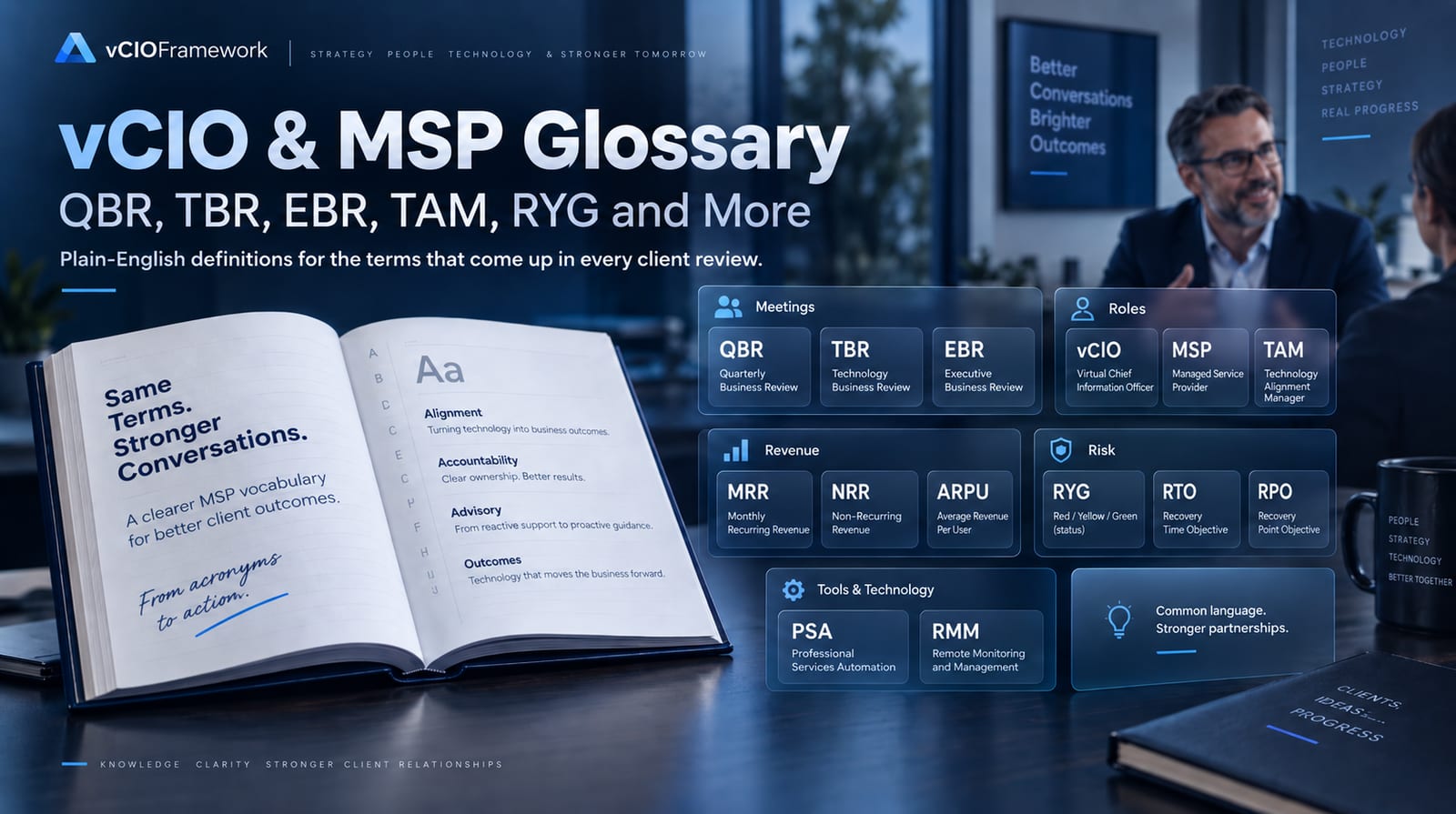
The Technology Alignment Manager (TAM) is the operational relationship owner. They ensure service quality, manage escalations, handle renewals, and run monthly touchpoints. They are the connective tissue between the client and the delivery team.
The vCIO is the strategic advisor. They score the client environment against the Standards Library, build and maintain the technology roadmap, run formal TBR and EBR meetings, identify project pipeline, and position the MSP as a trusted business advisor - not a vendor.
Mixing these roles in one person without a defined framework produces someone who does neither well. For smaller MSPs where one person must fill both roles, the solution is structured time allocation: reserve a defined block each month for vCIO-mode work and protect it from reactive interruption.
Step 2: Build the Standards Library
The Standards Library is the engine of the vCIO practice. It is a set of 100-plus yes/no questions that define what good looks like across every technology category - security, BCDR, networking, end user computing, cloud infrastructure, identity management, and compliance.
Every NO answer becomes a roadmap item. Every roadmap item gets a dollar value attached - cost of remediation, business risk of not remediating, or both. This is what converts a technical assessment into a commercial conversation. When you can show a client that their environment has 23 open NO answers representing $180,000 in prioritized remediation over 36 months, you have transformed the relationship from ticket management to strategic planning.
Build the Standards Library before you run a single TBR. It is the source material for everything that follows.
Step 3: Tier Your Clients
The four criteria that determine tier placement
Not every client deserves the same investment of vCIO time. Tiering is how you allocate that investment rationally.
Tier A clients - Always Engaged - are your highest-MRR, highest-complexity, highest-growth-potential accounts. They receive the full vCIO engagement: monthly TAM touchpoints, quarterly TBRs, and an annual EBR with executive leadership.
Tier B clients - Betterment Focused - receive semi-annual TBRs and a focused engagement around roadmap and risk. Tier C clients - Core Consistent - receive annual reviews and a lighter advisory touch. Tier D clients - Sustain - are managed operationally with minimal strategic investment.
Tiering criteria include: total MRR, contract complexity, strategic growth potential, relationship health score, and current roadmap adoption rate. Document the criteria and apply them consistently. Clients do not need to know their tier designation, but your team does.
Step 4: Define Cadence by Tier
Cadence is what makes the practice repeatable instead of aspirational.
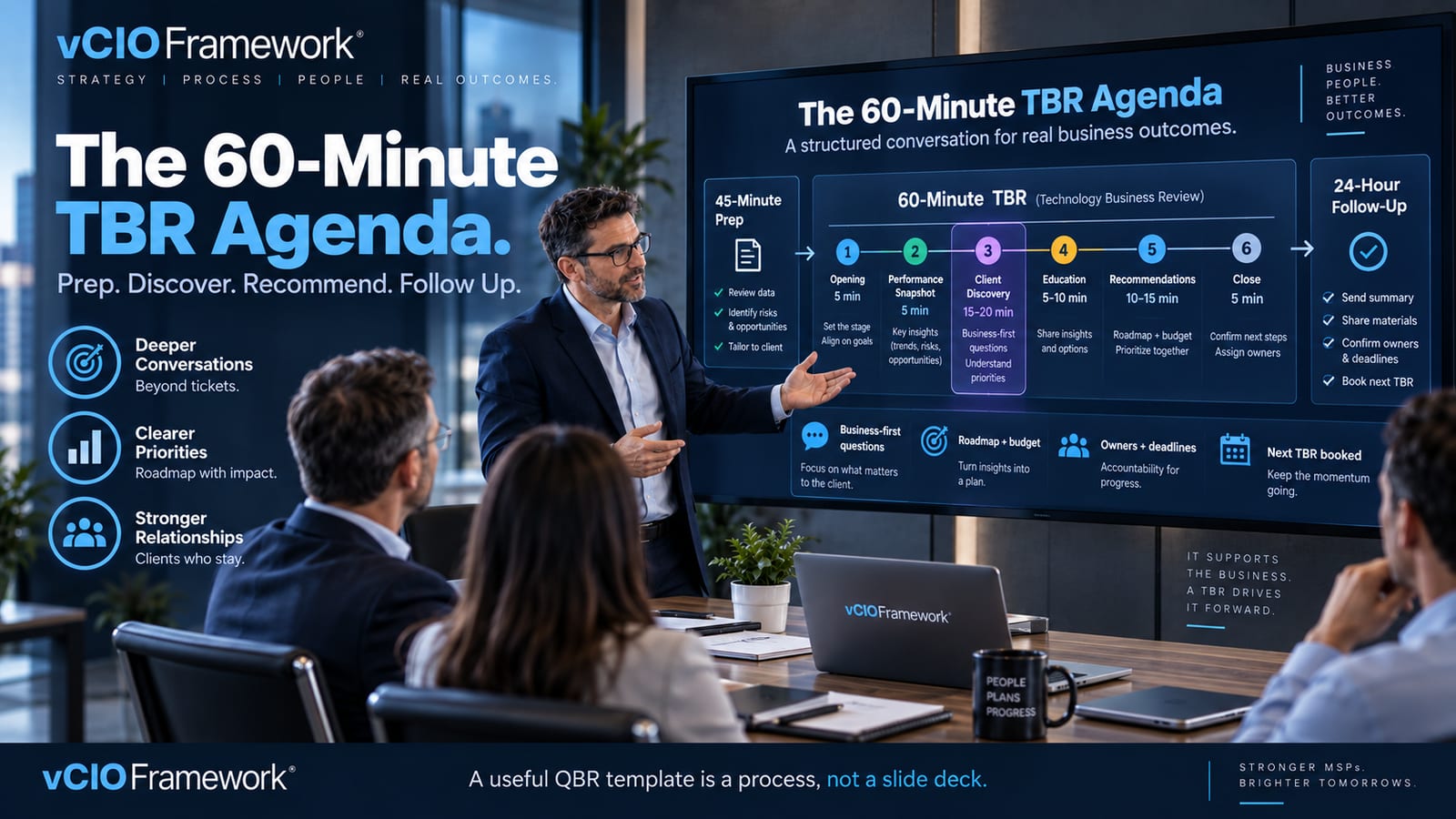
Tier A: monthly TAM touchpoint, quarterly TBR, annual EBR. The TAM touchpoint is operational - tickets, service delivery, upcoming projects. The TBR is strategic - scorecard, roadmap, pipeline. The EBR is visionary - business outcomes, multi-year direction, C-suite alignment.
Tier B: monthly TAM touchpoint, semi-annual TBR. Tier C: quarterly TAM touchpoint, annual TBR. Tier D: reactive touchpoints only, no formal strategic review cadence.
Map each touchpoint type to your PSA so the cadence is automated. Cadence that depends on individual memory does not survive personnel changes.
Step 5: Build Three Client-Facing Deliverables Before You Do Anything Else
Before you run your first vCIO engagement, you need three documents that make the value of the practice visible.
The Client Health Scorecard is a Red/Yellow/Green summary of the client environment across five dimensions: technical health, relationship health, financial health, security and compliance, and strategic alignment. Updated before every TBR. This is what the client sees at a glance when they want to know where they stand.
The Technology Roadmap is a prioritized 12-36 month plan of all open Standards Library gaps, with dollar estimates and proposed quarters for each item. This is the commercial output of the vCIO practice - the document that drives project revenue.
The Standards Alignment Report is the detailed output of the Standards Library assessment - every question scored, every NO documented with business-language impact language, and a summary score for each technology category. This is the methodology made visible to the client.
Build templates for all three before your first engagement. Blank-page deliverables do not get built consistently.
First 90 Days: What to Do and in What Order
The sequence that avoids the most common implementation failures
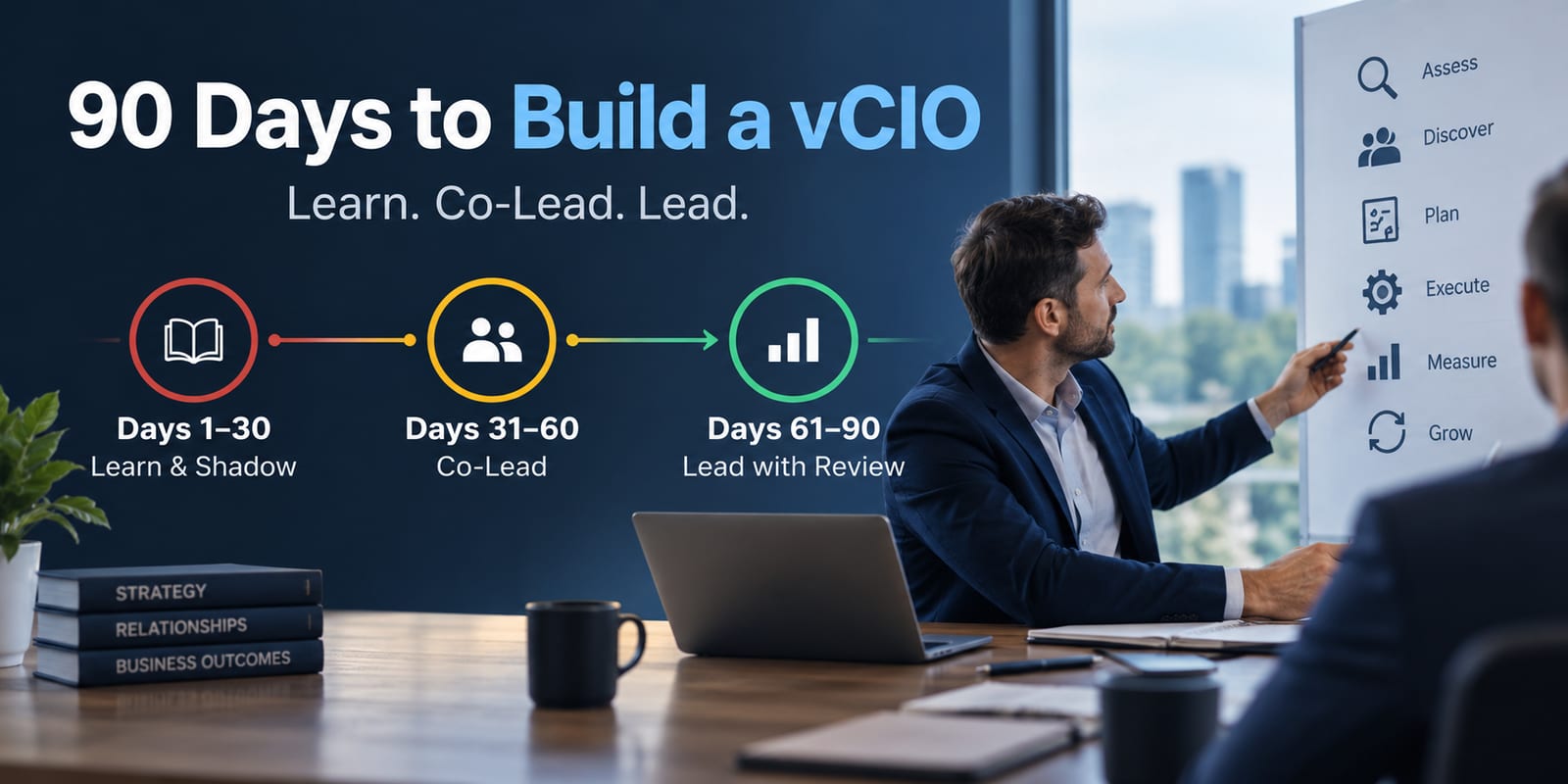
Days 1-30: Build the Standards Library (at least 80 questions across six categories). Define your tiering criteria and tier your existing client base. Assign each Tier A and Tier B client to a vCIO owner. If that owner is new to the role, our 90-day vCIO training plan runs alongside this sequence.
Days 31-60: Build your three client-facing deliverable templates. Run the Standards Library assessment on your top three Tier A clients. Score each client, document the NOs with dollar values, and build draft roadmaps.
Days 61-90: Run your first structured TBR with each of the three assessed clients. Introduce the Health Scorecard and Roadmap as deliverables. Get explicit client sign-off on the top three roadmap priorities. Document everything. Book the next TBR before leaving the meeting.
After 90 days: expand the Standards Library assessment to all Tier A and Tier B clients. Refine the deliverable templates based on what worked in the first three engagements. Begin the pricing conversation - vCIO should be a separate line item on renewal or upgrade.
The free vCIO Readiness Assessment scores your current practice across all six maturity dimensions and tells you exactly where the gaps are. The full methodology, Standards Library structure, TBR agenda templates, and deliverable frameworks are available in the vCIO Framework document library.
Frequently Asked Questions
How many clients should an MSP pilot the vCIO practice with first?
Start with 3-5 Tier A clients where you already have strong relationships and executive access. This gives you enough volume to refine the process without exposing your entire client base to an unpolished experience. Run the full TBR process, document what works and what does not, and use those pilots to build the templates and talking points before scaling to the rest of your book.
What is the minimum team size to support a vCIO practice?
A solo vCIO can manage 15-20 Tier A clients or 40-50 Tier B/C clients with a defined process and good documentation. Below 10 active managed clients, the investment in formalizing the practice rarely pays off - focus on growth first. Above 30 Tier A clients, a single vCIO becomes a bottleneck and a succession risk. The practice needs a second person or a defined handoff process before it reaches that size.
How do you introduce structured TBRs to clients who are used to informal check-ins?
Frame it as an upgrade, not a change. Tell the client you are formalizing the way you prepare for and document your strategic conversations so they get more value from the time they invest. Send a pre-meeting agenda for the first structured TBR. Bring a documented health scorecard and an updated roadmap. Most clients will not resist the upgrade - they will appreciate that you are taking the relationship more seriously than the previous informal format suggested.
The practice only works with the right commercial model behind it. See how to price vCIO services and understand where your MSP sits on the vCIO maturity model before you start selling advisory.
From the vCIO Framework
Get the vCIO Framework
14 modules, TBR/EBR templates, AI Advisory playbook, and RYG scoring rubrics. Free download. No lock-in.
Download Free